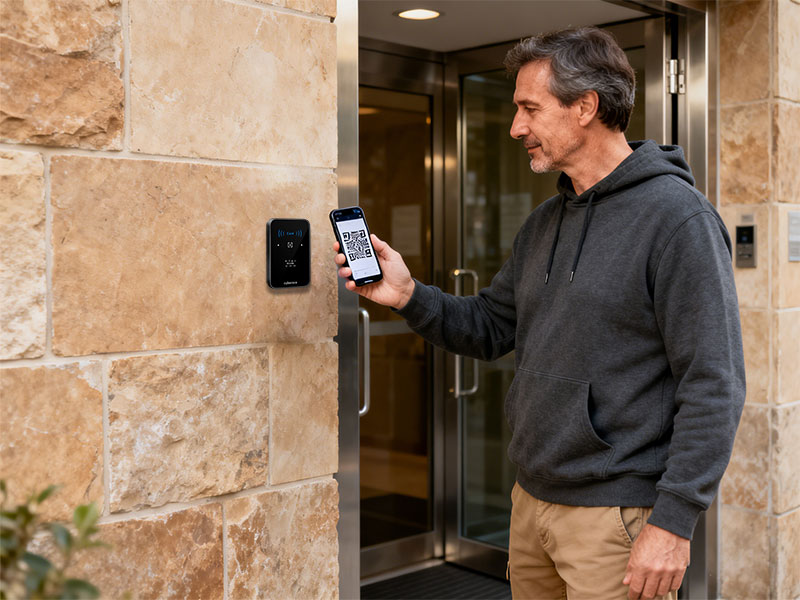
Our company's QR code access control system provides a rapid deployment solution for upgrading mid-range residential communities overseas. As a standardized hardware component, it integrates seamlessly with property management systems through a unified interface and supports multiple access methods, including card swiping and QR code scanning, ensuring lossless integration with existing systems.
Table of contents:
Text:
Research has found that the vast majority of mid-range residential communities abroad rarely adopt
QR code access control systems, particularly for managing temporary visitors, where traditional access control methods remain dominant. The primary access control methods include physical keys, passwords, RFID keychains/cards (primarily 125kHz low-frequency ID cards or 13.56MHz Mifare cards), audio/video intercom systems, and some newer communities using emerging app-based access solutions. The biggest headache for property management personnel is not the lack of functionality in access control systems themselves, but the rigid business logic and management backends inherent to each system, which lead to integration difficulties, data isolation, and a lack of innovation.
1. Prioritize software platforms, with QR code access control as the execution layer hardware
For system integrators and software platform providers specializing in mid to high end residential communities, the real challenge is not the implementation of access control functions, but how to seamlessly integrate access control systems with core PMS such as Yardi and RealPage, eliminating data silos.
This is exactly the starting point of our
QR code access control design concept: our hardware is a pure Execution Layer. Your platform interfaces with PMS through API. When a new tenant is created in PMS, the system platform only needs to send a command to our device through MQTT: 'Authorize this new credential'. The same applies when the tenant terminates the lease. For temporary visitors, the platform can dynamically issue temporary authorizations with time and frequency limits through the API, and the permissions will automatically expire after the appointment is completed. Throughout the entire process, your access control system is the only 'brain' and data center. Our hardware only faithfully executes the commands to open and close the door.
In addition, this architecture can also be integrated with the smart express cabinet system in residential areas. Your platform can integrate with the API of the courier company, and when the package is about to be delivered, your platform can dynamically generate a one-time QR code associated with the tracking number of the package.
Your platform logic is: 'When this specific QR code is scanned, authorization is granted to enter the gate and parcel room, valid for 5 minutes'. Our hardware, as the 'Execution Layer', does not need to understand that this is a package, it is only responsible for verifying this credential and executing the door opening. This allows you to build an extremely secure and intelligent end-to-end package management process for your customers.
2. Unified interface design for QR code access control, providing flexible expansion capabilities for system integrators
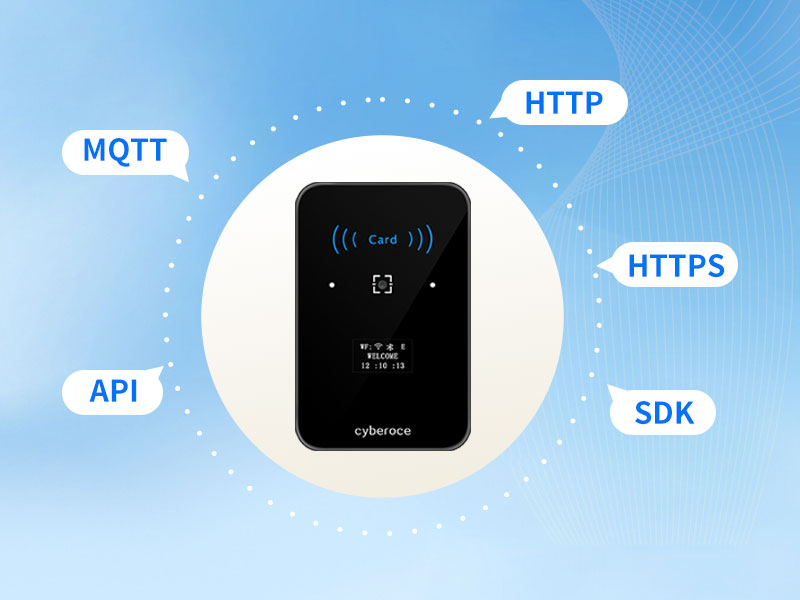
Our company's advantage lies not in the "single device", but in the interface and architecture design. All hardware supports standard HTTP/HTTPS/MQTT protocols, with consistent interface logic and forward compatibility with older versions. This means that the upgrade of community access control is not about "replacing a single device", but about "expanding access control capabilities on the basis of the original system", truly realizing a software platform that connects multiple hardware forms.
Taking the access control layout of mid-range residential projects that have already been implemented in Singapore as an example, the same community can be equipped with different forms of our hardware as needed:
*Community gate: Deploy QR code access control integrated machine
*Unit building door: Deploy QR code facial recognition machine (combining QR code and facial recognition functions)
*Elevator: Deploy a layer control elevator control motherboard without breaking wires, compatible with brands such as Otis, Tongli, ThyssenKrupp, etc., and suitable for about 98% of all types of elevators in the market.
The core advantage of our solution for adapting to multiple hardware forms mentioned above is that there is no need to adjust the architecture on the software side, and only the corresponding parameters need to be added to achieve full scene permission linkage.
For example, in a specific scenario of residential permission linkage: a resident lives on the 7th floor. When the resident passes the QR code verification at the entrance/unit door of the community, our elevator control motherboard will automatically receive permission instructions, light up the elevator 7th floor button, and the resident can directly reach the floor without additional operation.
This design upgrades the access control equipment from a single "entrance and exit control tool" to a standardized "residential access capability module", and our company becomes a hardware layer service provider and unified access interface provider for residential access control for overseas system integrators(Residential Access Control Hardware Layer, Unified Access Interface Provider). Laying the foundation for the expansion of functions and scene innovation of subsequent access control systems.
3. Non destructive upgrade design using QR code access control, without the need to dismantle the original access control equipment in the community
In order to reduce the renovation cost of upgrading the access control system in overseas mid-range residential areas and shorten the implementation cycle, our company has made multiple targeted non-destructive upgrade designs for the QR code access control hardware, achieving seamless compatibility with the original access control system in the residential area. The specific details are as follows:
A、 Compatibility with multiple recognition methods:
In addition to the scanning function, the QR code access control device also retains the ability to use both the 125kHz low-frequency ID card and the 13.56MHz Mifare card simultaneously, allowing residents in the community to continue using their original RFID keychains/cards without the need for replacement, minimizing the adaptation costs for homeowners.
B、 Parallel installation, jointly controlled electromagnetic lock
The equipment is equipped with independent relay outputs, and there is no need to remove the original access control equipment. The new device can be installed next to it and control the same electromagnetic lock as the original access control device.
C、 Head replacement mode
The QR code access controller(all-in-one) is equipped with a Wiegand output port, which can replace the original card reader with a QR code access control.
When swiping the card: output to the original controller through Wiegand, keeping the original logic unchanged
When scanning the QR code: The QR code data is uploaded to the platform's access control backend, and online verification permissions are reserved for visitors. After verification, a remote door opening command is issued to directly drive the door lock
Advantages: The original access control system does not need to be upgraded, and user permissions do not need to be changed. This not only ensures that the usage habits of the original card swiping users are not affected, but also achieves fine management of temporary visitors through the addition of a visitor system.
4. Summary: Why is our company's QR code access control suitable for overseas mid-range residential projects?
Our company's QR code access control system, with its three core advantages of unified standardized interface, as an execution layer hardware, and lossless upgrade design, provides a quick and practical hardware solution for the access control upgrade of overseas mid-range residential communities. This enables system integrators and software platforms to achieve:
In the initial stage, only basic access control permission management and visitor reservation functions were deployed to quickly complete the project landing;
Based on the operational needs of the project, gradually add new scenarios and functions such as elevator linkage and package management in the later stage;
The entire process does not require repeated replacement of the access control system, avoiding the time and cost loss of multiple interface connections.
This fully conforms to the gradual construction and upgrading pace of overseas residential projects, which not only reduces the trial and error costs of early-stage project investment, but also reserves sufficient expansion space for later functional iteration and scene innovation. It is a new solution for upgrading access control in overseas mid-range residential communities.
