Cerberus Technology specialized in QR Code Access Control for 11 years, providing hardware solutions for Grade A office buildings overseas. To meet challenges such as multi-tenant employee mobility and visitor management, we offer key features including over-the-air authorization, touch-free access, and remote management. Our Cyberoce systems are compatible with HTTP/HTTPS and MQTT protocols for seamless integration, supporting the digital transformation of modern smart buildings.
Table of contents:
TEXT:
Cerberus Technology specialized in
QR Code Access Control for 11 years, providing hardware solutions for Grade A office buildings overseas. To meet challenges such as multi-tenant employee mobility and visitor management, we offer key features including over-the-air authorization, contactless access, and remote management. Our systems are compatible with HTTP/HTTPS and MQTT protocols for seamless integration, ensuring compliance and privacy protection, reducing costs and increasing efficiency, and facilitating the intelligent upgrade of buildings.
QR Code Access Control has unique advantages in solving the problem of temporary visitor management in Grade A office buildings. Its features such as "online appointment, remote authorization, and contactless door opening" are irreplaceable by traditional access control cards, fingerprints, and facial recognition. Cerberus Technology is the original manufacturer of QR code access control, with 11 years of experience and technical accumulation. It provides HTTP/HTTPS and MQTT protocols for system integrators and software platform providers with development capabilities to achieve secondary integration for office building visitor management.
This article will start from the real pain points of Grade A office buildings in various countries overseas, especially new office needs such as cross-enterprise collaboration, temporary office, and multi-location communication within corporate groups. It will systematically analyze why traditional access control technologies fall short and introduce how
QR code access control can effectively solve these management challenges, helping Premium buildings achieve a more efficient, flexible, and secure intelligent upgrade.
I. Common Management Pain Points in Grade A Office Buildings in Various Overseas Countries

Pain Point
1: High employee turnover across enterprises makes traditional access control systems difficult to manage efficiently.
In Europe and America, many Grade A office buildings are multi-company mixed-use buildings, even the same group having multiple teams or project groups within the same building, and staff moving between floors and departments is very common. However, traditional access cards, fingerprints, and facial recognition registration have same requirements.
1. You need to go to the property front desk or management office to complete the process. When there are many people, you may need to register your personal information in long queen.
2. After an employee leaves the company, they must return their access card to the management office, and the administrator will manually delete their access permissions.
3. Employee cards are lost and need to be a new card (it poses a security risk).
For large-scale enterprises such as Amazon, Meta, Microsoft, Dell, and Oracle, this method proves remarkably inefficient, but also carries the risk of permissions not being revoked in a timely manner.
Pain Point 2: Cumbersome visitor management and poor user experience
Grade A office buildings have always had strict requirements for visitor privacy and security; however, traditional visitor processes often encounter the following issues:
1. Visitors often have to wait long times when registering their information at the front desk, especially when there are many people.
2. The front desk needs to contact relevant personnel at the visited company for confirmation.
3. During peak hours (such as Monday mornings), when there are many people, the processing time for temporary cards is long.
For businesses that frequently need to receive clients, this process is both time-consuming and detrimental to their business image.
Pain Point 3: Cross-group office work is becoming increasingly common, but permission systems cannot be shared.
Many multinational corporations face the following structural challenges in their operations across regions like Europe and America.
1. Parent company and subsidiaries operating under separate access system.
2. Share resources such as meeting rooms, finance departments, and server rooms-that need to be accessible to different divisions.
3. Internal employees on temporary assignments requiring short-term access to specific office locations.
In traditional access control systems with isolated permission frameworks, employees from a parent company or its subsidiaries must be registered as temporary visitors when working at each other's premises. This necessitates manually granting and later revoking temporary access—a process that is not only cumbersome but also prone to oversight, creating long-term security vulnerabilities due to improperly cleared permissions.
Pain Point 4: Service unavailability due to holidays and staffing shortages.
Grade A office buildings commonly encounter the following service issues:
1. No administrators on duty during weekends.
2. The front desk will off work on official holidays.
3. Staff cannot open doors during the evening and need to grant authorization immediately. If there is an emergency overtime or temporary work, regular staff cannot obtain temporary cards in timely, which seriously affects the workflow.
II. QR Code Access Control: A Modern Solution Specifically Designed to the Pain Points of Overseas Grade A Office Buildings
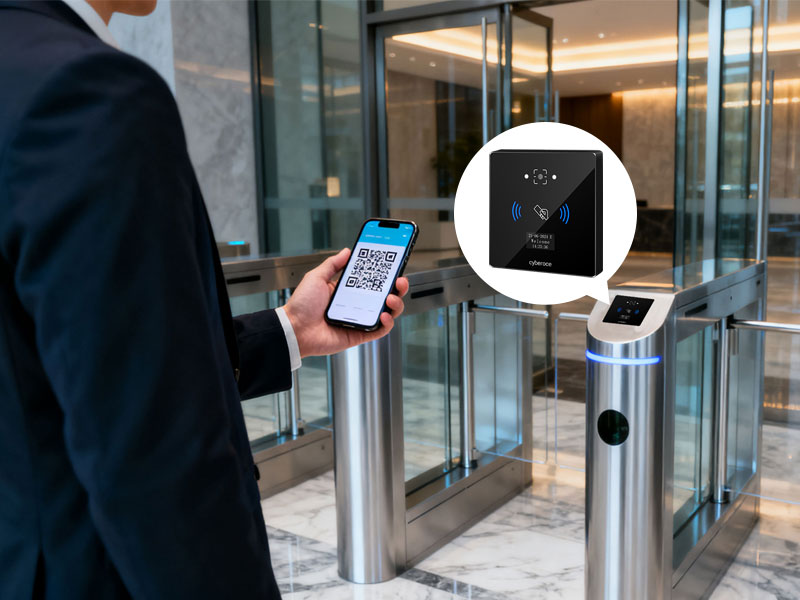
QR code access control almost perfectly resolves the above problems, achieving truly barrier-free access management with its characteristics of " over-the-air authorization, touch-free access, and remote management”.
".
Advantage 1: Remote authorization, no physical card or on-site registration required.
1. QR code access control eliminates the need for physical cards and front desk registration. Company administrators can log into the backend system from anywhere with internet access, using a computer or mobile app, and directly issue employees a QR code with time and limited access permissions.
2. The QR code for unlock the door automatically expires after an employee leaves the company, so there is no issue of cards being left behind.
For highly mobile multinational corporations or shared office teams, QR code access control can significantly reduce management costs.
Advantage 2: For temporary visitors, there are multiple reservation methods to enhance the visitor experience, with the process taking only seconds.
1. Active invitation method: Businesses fill in visitor information in the QR code access control system in advance and generate temporary access QR codes with limited time or number of uses, which are then sent to visitors via email or SMS. When visitors arrive at the office building, they do not need to queue for registration; they can simply scan the QR code to enter the access area.
2. Visitor self-filling method: The business sends an online appointment link to the visitor to fill out the form. After the visitor receives the information and reviews and confirms it, the visitor will receive a temporary door opening QR code with a time limit. The visitor can use this QR code to scan the door to enter the access area.
For medium and large enterprises that value efficiency and business image, this frictionless visitor experience better meets their professional needs.
Advantage 3: Internal staff do not need to register repeatedly, enabling seamless access control.
For group enterprises with extensive subsidiaries or cross-city operations, a unified system for issuing time-limited QR codes holds immense value. It allows internal staff on temporary assignment to access subsidiary offices seamlessly, without requiring local re-registration or new permissions from the host site.
Advantage 4: No manual intervention required; authorization can be processed normally even on holidays.
The core advantage of QR Code Access Control lies in its fully cloud-based capability for remote authorization. It empowers administrators to grant access instantly from any device with an internet connection, making after-hours, weekend, and holiday access seamless. This eliminates dependency on property staff and prevents work stoppages for employees. In overseas markets, especially in cost-conscious and automation-focused regions like Europe and North America, this is a transformative benefit.
Advantage 5: Superior Security with End-to-End Control and Auditing
The QR code access control system supports signature verification, allowing system integrators or software platforms to impose various security restrictions on the QR code for unlocking door according to the actual needs of the project, such as:
A. One-time QR code -Ideal for scenarios like employee package pickup, where single-use access is sufficient;
B. Dynamic QR code resistant to screenshot-Designed for personalized use cases such as meeting check-ins, ensuring only thee intended individual can unlock the door.
C. Automatic permissions expiration- Eliminates security risks by setting time-limited access. For example, when an employee is assigned to assist a subsidiary for 10 days, their QR code will automatically expires after the period.
D. RC-4 encrypted QR Codes- Encrypted codes transmitted in ciphertext form, making them extremely difficult to crack.
Meanwhile, all access behaviors can be recorded in real time and are traceable. Compared to traditional cards that are easily copied or misused, QR code access control provides a significantly higher level of security.
III. The Comprehensive Value of QR Code Access Control for Grade A Office Buildings
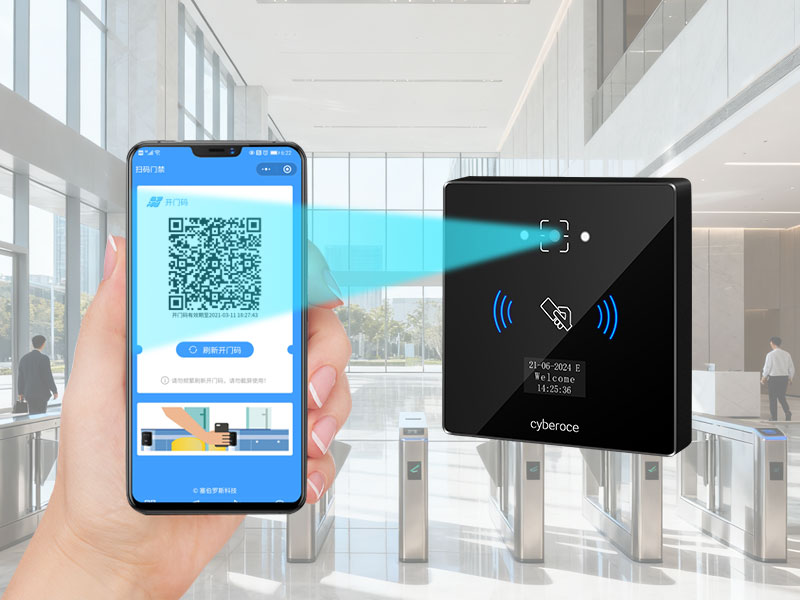
In summary, QR code access control is not just a technological upgrade, but a comprehensive revolution in management efficiency:
QR code access control not only solves management pain points, but also deeply aligns with the core needs of Grade A office buildings in Europe and America:
1. Privacy protection compliance: It eliminates the need to collect employees' or visitors' biometric information such as fingerprints or faces, using QR codes for identity verification instead. This fully complies with stringent privacy laws like the EU's GDPR and mitigates the risks associated with biometric data breaches.
2. Strong Adaptability to Digital Tools: Given the widespread adoption of digital office suites by Western enterprises, QR code systems can be seamlessly integrated into any third-party software platform. This allows them to fit naturally into a company's existing digital ecosystem, reducing barriers to adoption.
3. High scalability: It supports flexible expansion based on building size, tenant numbers, and personnel flow. It can be integrated with building management system (BMS) to achieve interconnection and interoperability of data such as access control, visitors, and security. This helps office buildings build a smart office ecosystem.
4. Reduce management costs- It significantly decreasing the procurement, authorization, issuance, employee collection, and manpower for physical access control cards.
QR code access control is not just an access control system; it's a vita tool for improving building operational efficiency, optimizing the office experience for businesses, and enhancing market competitiveness. Choosing QR code access control means choosing a smarter, more convenient, and more secure access management model.
