This article explains how Cyberoce integrates five Identification methods—RFID cards, barcodes, QR codes, PIN codes, and remote unlocking—into a single terminal, helping factories, industrial parks, and residential communities manage users with different identities more efficiently, while reducing hardware complexity and deployment costs.
Table of contents:
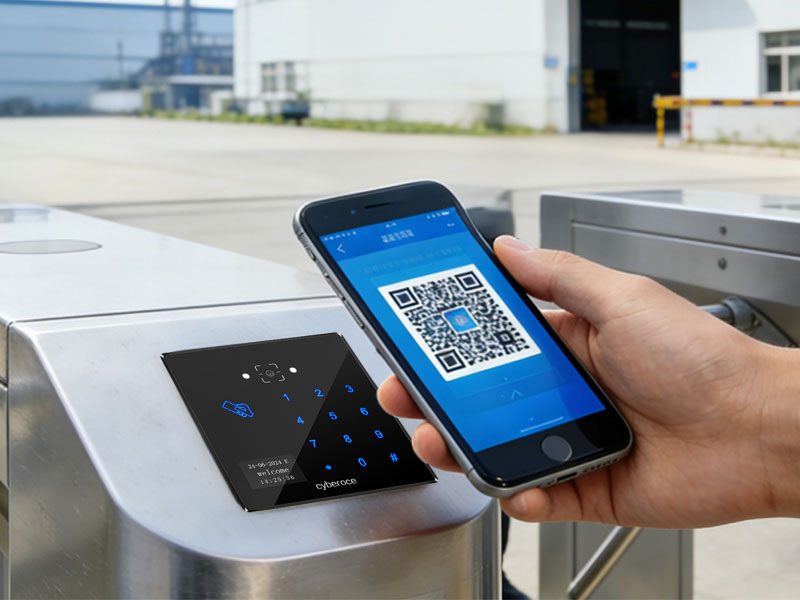
Text:
As an access control manufacturer that focuses on practical project implementation in niche areas of the security industry, Cyberoce understands that in factories, office parks, communities, and public places, a single mode of access can no longer meet the complex personnel structure and management needs.
Permanent employees, visitors, outsourced personnel, temporary workers, and management all have different identities, access permissions, and usage periods, which requires access control systems to offer a high level of flexibility.
Cyberoce's
access control with QR Codes product breaks away from the traditional "single identification" approach, integrating five mainstream access credentials into a single terminal. While maintaining stable operation, it enables more efficient management of different user groups and application scenarios.
I. An Access Control with QR Codes terminal that integrates five identification methods.
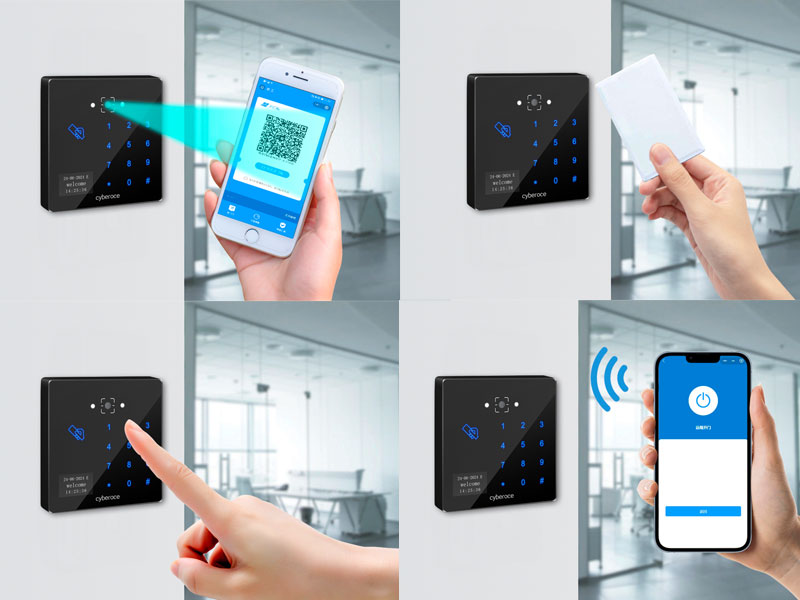
1. Traditional RFID cards (Mifare & EM Card)
• Supports 13.56MHz Mifare cards
• Supports 125KHz EM cards
Target Users: Homeowners, regular employees, long-term members
RFID cards remain a fundamental access method in many projects. Cyberoce access control devices support mainstream card types, making it easier to upgrade existing systems without large-scale replacement of cards or credentials.
2. QR code access
QR codes as one of the most flexible and cost-effective access methods, making them especially suitable for environments where personnel change frequently and access permissions need regular adjustment.
Applicable scenarios:
• Visitor access
• Temporary workers, outsourced personnel, and third-party service staff
• Shared offices and shared facilities (gyms, meeting rooms, tea rooms, shared entertainment spaces, etc.)
• Ticket verification at scenic areas, exhibitions, and similar venues
Access Control with QR Code can be configured with specific validity periods, usage limits, and permitted access areas based on actual requirements.
QR Codes expire automatically, and all access activities are fully traceable. Since no physical cards need to be issued or collected, management issues related to the production, distribution, and loss of temporary cards are significantly reduced.
3. One-dimensional barcode
In many commercial and public service environments, one-dimensional (1D) barcodes remain a mature, stable, and widely used identification method.
Applicable scenarios:
• Ticket verification at stations, venues, and similar locations
• Shopping mall receipt verification
• Verification of various vouchers and redemption codes
Using 1D barcodes, the same access control terminal can be used for personnel access, also for ticket verification, redemption, and related services. It reduces the need for dedicated devices, improves equipment utilization, and helps avoid unnecessary duplicate investment.
4. PIN Code
Traditional access control systems often rely on Pincodes to unlock the doors. For modern access control systems, Pincodes access is a simple and direct supplementary method, and it remains very practical in many scenarios.
Applicable scenarios:
• Bosses, management , and other personnel with fixed high authority
• High-privilege alternative access method
• Emergency use in emergency or special circumstances
When networks, accounts, or other means of identification are temporarily unavailable, Pincodes can serve as a reliable backup to ensure that key personnel can pass through normally.
5. Remote unlocking the door
Remote unlocking primarily addresses situations where management personnel are not on-site but immediate release is required.
Applicable scenarios:
• Administrator remotely authorizes door opening
• Remote access for temporary visitors
• Unattended or non-working period management
Remote operation can reduce on-site human intervention and improve processing efficiency, making it suitable for management environments such as parks, office buildings, and locations with dispersed locations.
II. The actual value of access control with QR Codes devices integrate multiple access methods
Integrating multiple access methods into a single QR code–based access control terminal is not about adding more functions, but about effectively addressing the complex personnel structures and changing access rules commonly found in real-world environments such as factories, industrial parks, and residential communities.
In actual deployment and long-term use, this integrated approach delivers clear and practical benefits:
• In the initial deployment phase, fewer equipment types are required, making installation and site placement simpler.
• The system has a clear structure, and different access methods are managed under the same set of rules.
• Regular staff, temporary staff, and visitors can each use appropriate methods.
• When personnel frequently change in and out of the office, only permissions need to be adjusted, without the need for repeated hardware modifications.
Whether it's RFID cards, QR codes, 1D barcodes, Pincodes, or remote unlocking, they all operate around the same access control terminal and the same system, with clear management logic and less daily maintenance burden.
QR code access control solution designed for real-world projects
As an access control equipment manufacturer, Cerberus always focuses on one core issue in its product design:
whether the equipment can be used stably and sustainably on-site for a long period of time, and how easy it is to manage later.
Therefore, we use QR code access as the core, while retaining commonly used methods such as RFID, password, 1D barcode and remote unlocking, so that the same device can be adapted to different people, different usage cycles and different management habits.
The goal is to ensure the system continues to function even when scenarios or personnel structures change, rather than requiring a complete overhaul, have options, flexibility, and adaptability during actual operation.
One terminal, multiple access methods. It is more suitable for on-site use and better meets the needs of long-term management.
